Tag Archive: “reviews”
What I’m Reading: 2025
- Dinosaurs: New Visions of a Lost World, by Michael J. Benton, illustrated by Bob Nicholls. See the companion website Dinosaur feathers and colour for an accessible synopsis of the science behind recent advances in dinosaur paleontology.
- ★ New Adventures in Space Opera, edited by Jonathan Strahan. This post is partly inspired by Strahan’s own Consumed in 2025 list.
- New Edge Sword & Sorcery #3, edited by Oliver Brackenbury.
- New Edge Sword & Sorcery #4, edited by Oliver Brackenbury.
- The Player of Games, by Iain M. Banks.
- The Profitable Artist, published by the New York Foundation for the Arts.
- Playing with Pop-ups, by Helen Hiebert. Packed with inspiration for papercraft mail art!
- Drawn Testimony: My Four Decades as a Courtroom Sketch Artist, by Jane Rosenberg.
- ★ The Best American Science Fiction and Fantasy 2024, edited by Hugh Howey and John Joseph Adams.
- The Mercy of Gods, by James S. A. Corey
- ★ A Psalm for the Wild-Built, by Becky Chambers
- James Tiptree, Jr.: The Double Life of Alice Sheldon, by Julie Phillips…
- Lady Churchill’s Rosebud Wristlet #49, edited by Kelly Link and Gavin Grant
- A Prayer for the Crown-Shy, by Becky Chambers
- Never Say You Can’t Survive, by Charlie Jane Anders
- Where the Axe is Buried, by Ray Nayler
- Twelve Trees, by Daniel Lewis
- Blacks on John Brown, edited by Benjamin Quarles
- ★ Alpha 6, edited by Robert Silverberg
- The Kaiju Preservation Society, by John Scalzi
- The Space Merchants, by Frederik Pohl & C. M. Kornbluth
- Osama, by Lavie Tidhar
- Nebular Award Showcase 60, edited by Stephen Kotowych…
Comics
I read a variety of comics on Hoopla via the library. Listed here are some series I’ve completed or kept up to date with:
- Paper Girls: The Complete Story (Image Comics), written by Brian K. Vaughan with art by Cliff Chiang, Matt Wilson, and Jared K. Fletcher.
- Conan the Barbarian (Titan Comics), written by Jim Zub with art by Rob De La Torre, Doug Braithwaite, and Danica Brine.
- The Savage Sword of Conan (Titan Comics), by various writers and artists.
- The Witcher (Dark Horse Comics), by various writers and artists.
- The Eternaut (Hora Cero 1957—1959/Fantagraphics 2015), by Héctor Germán Oesterheld with art by Francisco Solano López, translated by Erica Mena and Martin Hadis…
- Suffrage Song: The Haunted History of Gender, Race, and Voting Right sin the US, by Caitlin Cass.
- Blue Book (Dark Horse Comics), written by James Tynion IV with art by Michael Avon Oeming.
Posted on Sunday, January 12th, 2025. Tags: reviews.
A Limerick, the Throne of the Crescent Moon, and Places in Fiction

Here’s a limerick about Throne of the Crescent Moon, the debut novel by Saladin Ahmed:
There was a wise man from Dhamsawaat
who lived with a boy who prayed and fought.
The man loved an old whore,
who deplored the ghul war,
and the boy met a girl who was not.
(With apologies to Zamia and Raseed for making light of their story – but I suspect Doctor Makhslood would embrace a harmless bit of impious doggerel!)
I enjoy stories with a strong sense of place.
Examples large and small come to mind: sordid New Crobuzon from China Miéville’s Perdido Street Station (not to mention the conjoined cities of The City & The City); Green Town, Illinois – distillate of gothic Americana that it is – from Bradbury’s Something Wicked This Way Comes; all of the burgeoning desert planet Arrakis from Frank Herbert’s Dune; and even Redwall Abbey from the Brian Jacques series of the same name.
Vivid impressions of these places root them in my memory.
I think that in the Crescent Moon Kingdoms – and especially the big, bustling, central city of Dhamsawaat – Ahmed may have created a similarly memorable setting. The main character Aduolla Makhslood is an expert ghul hunter and affable old fart who is all the more relatable for his relation to the places he inhabits: his favorite tea house, his run-down neighborhood, and his own dear home. So, as with the examples above, Aduolla’s world has become a part of mine.
(Links to related short stories…)
Posted on Saturday, July 20th, 2013. Tags: books, limerick, reviews.
Haiku Review of Nightmare Magazine #1
I’m a fan of editor John Joseph Adam’s Lightspeed Magazine, which publishes fantasy and science fiction, so I was intrigued by the announcement of Nightmare Magazine, a sibling venue for scarier stories. (Full disclosure: I made a token contribution to the Kickstarter project.)
The first issue was released this month, just in time for the Halloween season. I read it last week… and I survived! Here are one-line synopses and rhyming pseudo-haiku reviews of the four stories in Nightmare Magazine issue one.
Property Condemned by Jonathan Maberry
Bitter reflections
splinter young friends’ directions;
weakness, seen, may sprout.
On a dare, four kids confront the contents of an ominous house.
Frontier Death Song by Laird Barron
Good dogs, guns, and frost;
huntsmen whisper, howl, and stalk.
Quarry, cornered, caught?
A reunion of outdoorsmen renews the hunting season.
Good Fences by Genevieve Valentine
Peering down the street –
vandals; burned out cars; debris.
“No one cares but me.”
Evidence of urban decay agitates a troubled man.
“Limbo kids, be free –
move on, grow, and haunt not me.”
Teacher, hark to thee.
A woman struggles to soothe her pupils while coping with crises of her own.
Posted on Saturday, October 13th, 2012. Tags: haiku, magazines, reviews.
Imperative Precautionary Haiku Reviews of the Stories in “Earthmen & Strangers”
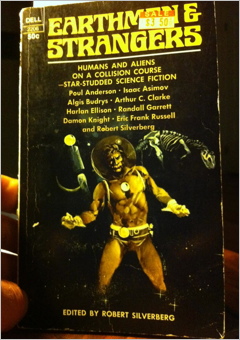
I recently picked up a used copy of Earthmen and Strangers, a 1966 anthology of short stories edited by Robert Silverberg. As the cover attests, the book contains “humans and aliens on a collision course – star-studded science fiction.”
In 2010, I posted some haiku reviews of stories I’d recently read. I did some limericks as well. They were all very cheesy, but fun to write. Now I am reviving the gimmick with a new series of haiku reviews. In this post, there is an additional conceit – each bit is phrased as a vague sort of warning to some character or group in the story.
As before, it would be better to call these “synopses” or “selected impressions” instead of reviews. My intent is not to decree whether they have any literary merit, and certainly not to tell you what you should or should not read. In some cases, of course, I can’t help but comment on aspects that would seem out of place if these were written today. The haikus are just a fun record of what I’ve read. Hopefully they give you a taste of what I got from each tale.
Title and author links go to bibliographies at The Internet Speculative Fiction Database.
Dear Devil by Eric Frank Russel
Leave us your poets,
wise passers-by, for who else
might notice hope here.
A Martian artist lingers on ruined Earth, clumsily raising the remnants of humanity.
The Best Policy by Randall Garrett
Listen, my liars –
if cornered by creatures,
the truth will set you free.
Tactful answers to an alien polygraph avert invasion.
Wade among many,
emissary, but risk wanes
your identity.
Rugged individualists from earth make poor company for a little collectivist.
Stand up for yourselves,
women of hot shade and shell;
your men are not gods.
Stranded spacemen help the ignorant natives dispel an abusive cult and seek gender equity. Don’t worry, it’s not a white savior scenario: one of the men is Basque and the other Mohawk!
The Gentle Vultures by Isaac Asimov
Don’t be so hasty,
postwar planet beachcombers,
to assume our doom.
Opportunistic invaders are frustrated by our failure to destroy ourselves.

Stranger Station by Damon Knight
Question the motive
of the gift of elixir –
be tamed and changed by the ichor.
The new human occupant of a lonely trading post prepares for the periodic return of the other party.
I thought this was the most compelling story in the collection. Perhaps it is because the stranger is a truly alien presence: there are no little green men or translator hats here.2
The protagonist suffers from a desperate sense of anxiety and belated revelation as the alien approaches. His urgent effort to understand the purpose of the rendezvous – complicated by the calculated recalcitrance of his computer companion – convincingly depicts what it is like to confront the unknown.
Lower Than Angels by Algis Budrys
Patience, prospector,
lest your raw materials
make too much of you.
A small town sheriff is seduced by a victim’s widow.
Wait, wrong synopsis. This isn’t the NYT best seller list! Here we go:
A scout strives not to deceive the people he meets, but first impressions prove hard to shake.
Blind Lightning by Harlan Ellison
In case of capture,
give courage to your captor.
Release; death; rapture.
A disgraced scientist finds redemption by aiding his aggressor.
Out Of The Sun by Arthur C. Clarke
Behold, a last gasp
is glanced, like rippled glass,
as solar souls elapse.
Astronomers on Mercury see traces of something more than plain old radiation in the radar scans of a short-lived coronal mass ejection.
Some general criticisms:
-
All of the earthmen are exactly that: men. (Not counting the girls abducted to help restart society in Dear Devil.) Women: the greatest alien of all to the men of 1950s science fiction?
-
Many of these stories rely on an automatic communicator or translator device to facilitate dialogue between the titular earthmen and strangers. I think this makes the alien seem more like the merely foreign, with an attendant risk of portraying the aliens as little more than funny-colored people with weird cultures to figure out – or vice versa.
But, more generously, I recognize that the universal translator is a rhetorical device that helps a story advance beyond the mechanics of first contact to a “dialectical” phase where the story’s main ideas can be discussed directly by the characters themselves.
Last but not least, here are physical descriptions of some of the authors, as editor Robert Silverberg saw fit to include in his introductions to their stories:
- Eric Frank Russel is “a towering Englishman”
- Randall Garrett is “a bearded, booming-voiced man”
- Poul Anderson is “a lanky chap of Viking descent”
- Isaac Asimov is “jovial and even boisterous in the flesh”
- Damon Knight is “a slender, soft-spoken man with a deceptively mild smile”
- Algis Budrys “has the general dimensions of an outstanding fullback”
Posted on Wednesday, October 10th, 2012. Tags: art, books, haiku, reviews.
Lord of Light, Ilium, and Mythology in SF
My appreciation of Dan Simmons’ novel Ilium was greatly enhanced by my prior reading, in translation, of the actual Iliad. A passing familiarity with some of Willy Shakespeare’s work was helpful, too. The sort of literary name-dropping and cultural cross-referencing encountered in Ilium is called “intertextuality” in word-nerd circles. Whatever; it served to weave the world inhabited by Ilium’s characters into the world inhabited by Ilium’s well-read readers, and that’s a nifty trick.

(And isn’t it interesting how references to familiar works of fiction or mythic tradition constitute references to the reader’s “real world”? Dude, what is reality, anyway? )
More recently, I read Roger Zelazny’s Lord of Light. A captivating book, and especially fun to figure out without any advance knowledge of the setting – so don’t read that Wikipedia synopsis if you plan to read the book. Suffice to say that the Lord of Light story is deeply rooted in the Hindu tradition. It’s a good read even if you don’t know much about Hinduism, but I suspect that, as with Ilium and the Iliad, the read would be richer if you did. I’m sure there are layers of foreshadowing and suspense transparent to me which add texture to the tale for those more familiar with the personalities and themes of Hindu mythology.
(A common concern of Ilium, Lord of Light, and many other parables, science fictional or not: the hubris of those who would be gods.)
So what are some other examples of how your familiarity with one set of stories informs your understanding and appreciation of another? Bonus question: how does real-world mythology contribute to fictional worldbuilding?
Posted on Monday, September 3rd, 2012. Tags: reviews, sf.
Thinking Critically About Tolkien
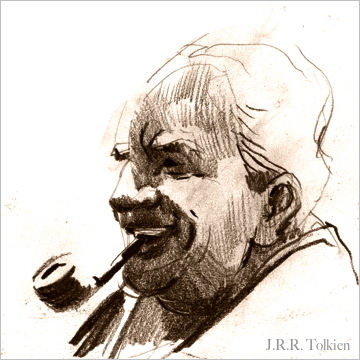 The works of J.R.R. Tolkien have had a tremendous impact on fantasy fiction and, arguably, on popular culture. Renowned for the scope and rigor of its conception, Tolkien’s Middle Earth is familiar to many as an exemplar of the fully-imagined secondary world, replete with language, history, and a complex mythological (if not moral) landscape. World-building of such detail provides a potentially powerful framework for fascinating story-telling – and indeed, the epic quest of the Fellowship of the Ring set the mold for generations of subsequent adventure stories.
Yet for all its influence and entertainment value, The Lord of the Rings is not beyond critique. Here I would like to share a few thought-provoking criticisms from other authors I respect. My intent is not to negate your enjoyment of Tolkien, but to enrich the way you think about what you read and how it relates to the “real world” in which you live. That, at least, is the impact these ideas have had on me.
The quotes I’d like to relay share a concern with the worldview and political structure evident in the quasi-medieval culture of Middle Earth. Plots are driven by conflict and conflicts can reasonably emerge from the social environment characters occupy. It is not necessarily the society of Middle Earth itself that these authors object to, I think, but the way in which Tolkien aligns thematic elements of good and evil – of propriety and upheaval – with elements of that setting.
 Consider Fantasy and revolution: an interview with China Miéville, conducted by John Newsinger, from the autumn 2000 issue of International Socialism Journal. Miéville is an author closely associated with the “New Weird” and a vocal observer of real-world social issues. Here, he fingers Tolkien’s romanticization of feudalism, a recurring theme in fantasy criticism:
If you look at stereotypical ‘epic’ or ‘high’ fantasy, you’re talking about a genre set in magical worlds with some pretty vile ideas. They tend to be based on feudalism lite: the idea, for example, that if there’s a problem with the ruler of the kingdom it’s because he’s a bad king, as opposed to a king.
In a January 2002 Socialist Review article titled Tolkien – Middle Earth Meets England, Miéville elaborates on the problem of simplistically categorizing characters as good or bad:
Tolkien wrote the seminal text for fantasy where morality is absolute, and political complexities conveniently evaporate. Battles are glorious and death is noble. The good look the part, and the evil are ugly. Elves are natural aristos, hobbits are the salt of the earth, and – in a fairyland version of genetic determinism – orcs are shits by birth. This is a conservative hymn to order and reason – to the status quo.
And all dwarves love gold!
Miéville does temper his critique. He has kind things to say about the Lord of the Rings movies (then just released) – “Jackson beefs up Tolkien’s rizla-thin women, turning them into actual characters” – and even admits admiration for aspects of the original:
it would be churlish to claim that there’s nothing to admire in the book. The constant atmosphere of melancholy is intriguing. There are superb, genuinely frightening monsters, and set pieces of real power.
But the bottom line is clear. Miéville admires the world-building, and embraces the inventive modes of story-telling possible with fantasy, but feels let down by the direction of Tolkien’s vision:
He established a form full of possibilities and ripe for experimentation, but used it to present trite, nostalgic daydreams. The myth of an idyllic past is not oppositional to capitalism, but consolation for it. Troubled by the world? Close your eyes and think of Middle Earth.
China dismisses most charges of escapism as genre snobbery – “just because [non-genre] books pretend to be about ‘the real world’ doesn’t mean they reverberate in it with more integrity” (ISJ) – but, ultimately, faults Tolkien for exactly that – escapism. Or, more accurately, for making too little of the liberating opportunities afforded by literary escape.
 Next I’d like to recommend J.R.R. Tolkien vs. The Modern Age, a 2002 essay by David Brin. Only an excerpt is available online, but the full text can be found in Through Stranger Eyes, an interesting collection of essays, reviews, and other non-fiction by Brin.
Brin’s critique affirms Miéville’s concern with the backwards-looking undercurrents of The Lord of the Rings. He extends this argument and situates it in historical context with a comparison of Romanticism and Enlightenment ideals.
He also asks the unsettling question of whether fantasy fans may, somehow, develop a misplaced fondness for the archaic social order familiar to their favorite characters:
Indeed, the popularity of this formula [LOTR’s] is deeply thought-provoking. Millions of people who live in a time of genuine miracles – in which the great-grandchildren of illiterate peasants may routinely fly through the sky, roam the Internet, view far-off worlds and elect their own leaders – slip into delighted wonder at the notion of a wizard hitchhiking a ride from an eagle. Many even find themselves yearning for a society of towering lords and loyal, kowtowing vassals.
I don’t think I’ve ever yearned for that, but I certainly root for the good guys to crush the bad. That’s almost instinctive. Brin wonders: what does this moral partitioning reinforce in our own worldview when used for dramatic effect in fiction? The device is hardly unique to The Lord of the Rings, of course, but once more the hapless orcs serve as an example:
The urge to crush some demonized enemy resonates deeply within us, dating from ages far earlier than feudalism. Hence, the vicarious thrill we feel over the slaughter of orc foot soldiers at Helm’s Deep. Then again as Ents flatten even more goblin grunts at Saruman’s citadel, taking no prisoners, never sparing a thought for all the orphaned orclings and grieving widorcs. And again at Minas Tirith, and again at the Gondor Docks and again… well, they’re only orcs, after all.
There is a strain of dismay with industrialization in Tolkien’s work. This is understandable, considering the threat mechanization poses to traditional Shire-like lifestyles –
the good guys strive to preserve and restore as much as they can of an older, graceful and ‘natural’ hierarchy, against the disturbing, quasi-industrial and vaguely technological ambience of Mordor, with its smokestack imagery and manufactured power-rings that can be used by anybody
– but Brin offers a compelling rebuttal to Tolkien’s tactic of nostalgic withdrawal:
The planet was certainly less abused when our numbers were kept low by poverty, starvation and disease. Now we must replace those old corrective forces with new ones – knowledge, foresight, and self-restraint.
So say we all.
•
I think it’s charming that Miéville, an avowed “active revolutionary socialist”, and Brin, a champion of the Enlightenment tradition and pragmatic American know-how, find so much common ground in their critical readings of Tolkien – and also in their use and espousal of the fantastic and the futuristic as lenses to perceive our path through the present.
•
I hope you agree with my initial assurance that the critiques I’ve shared here do little to detract from the stories they dissect. If this post has exposed you to any new ideas, or nudged you to consider what you expect from fiction, or perhaps even caused you to articulate a rebuttal of your own against any of the charges recounted here, then I consider it a success.
I do not think the quotes I’ve selected do justice to each author’s arguments (least of all Tolkien’s), so please consider reading the source materials in their entirety. If you haven’t read The Lord of the Rings, start with that!
For Tolkien criticism of a different sort – more reverential, perhaps, but rife with insight into the structure and function of fiction – check out Corey Olsen’s extensive Tolkien Professor podcasts.
Posted on Thursday, March 15th, 2012. Tags: books, reviews.
Orbital Drop eBooks
Do you like science fiction and fantasy? Do you read ebooks? You might want to check out The Orbital Drop, a monthly deal on an ebook title from publisher Orbit Books.
The currently discounted title is Consider Phlebas
I read a more recent Culture novel last year (Matter)
Posted on Tuesday, April 5th, 2011. Tags: books, reviews, tbr.
Art on Anarres
This quote from Ursula K. Le Guin’s The Dispossessed
“No distinction was drawn between the arts and the crafts; art was not considered as having a place in life, but as being a basic technique of life, like speech.”
(As with art, so with science.)
The quote is an excerpt from a description of the egalitarian culture of the protagonist’s homeland.
The book is a dialectical dissection of ideas about culture and society and belonging and belongings, told through the device of the main character’s attempt to bridge two very different but intimately related worlds. From my vantage point halfway through the book, the central question is whether the two peoples will be reunited – or whether the reuniter will ultimately find himself without a people. The title underscores that risk, and reminds me of the challenges faced by all who would seek compromise.
Posted on Sunday, April 3rd, 2011. Tags: art, books, quotes, reviews.
Haiku Reviews of Selected Stories from Fragile Things, a Compendium of Short Fiction by Neil Gaiman
Here’s my take on a few of the tales from Fragile Things: Short Fictions and Wonders
The boy ran away
and found a friend with whom to play
and maybe stay.
In high school, some of our cross country routes took us through a cemetery. Some folks said it wasn’t an appropriate place to run, but I always figured the residents wouldn’t mind the company.
Who is the demon
who resurrects your regrets?
Feelings, flayed, expire.
Gaiman’s comments on this compact parable introduced me to the “Möbius story” label for cyclical stories. This is the first of two or three summarized here.
The Facts in the Case of the Departure of Miss Finch
Evening on the town:
at the circus, underground,
kingdoms, lost, are found.
While they were in the fifth room, the prim biologist said she wished the Smilodon was not extinct. In the eighth room, the Cabinet of Wishes Fulfill’d, she was chosen as a volunteer.
Apparently this story was partly inspired by a Frazetta painting. Awesome.
We all have our needs –
a hunger for friends, or meat;
and some of us feed.
Ever run in to someone you used to know, and wonder what happened to them? Ever wish they hadn’t told you?
Pages from a Journal Found in a Greyhound Bus Somewhere Between Tulsa, Oklahoma, and Louisville, Kentucky
Dreams of roads and rain
in America’s motels,
searching for yourself.
There’s no better place to work out what you’re after than a booth at an all-night diner. If that doesn’t lead anywhere, you might really be lost – or at least there’s a long road ahead. Refill?
Barbecue Sunbird –
a summer delicacy!
Ashes, hatch, repeat.
I want to hang out with Zebediah T. Crawcrustle.
Each year, here we meet
to drink and feast but most to
make you monsters weep.
This story features characters from American Gods
Posted on Tuesday, June 15th, 2010. Tags: books, haiku, reviews.
Story Synopses for May 26
I have backlog of notes on story podcasts. Here are limerick synopses for a scant few of them:
Remembrance Is Something Like A House by Will Ludwigsen (via Podcastle 100)
A house that was home is forsaken;
abandoned in shame, it awakens.
With a creak and a lurch
it sets off on a search
to put right what once was mistaken.
Acceptable Losses by Simon Wood (via Pseudopod 191)
Mission’s the same, boys – collect our dead
with shovels and buckets and dread.
Many battles are won
and the Queen thanks you, son,
for her best weapon needs to be fed.
Intelligent Design by Ellen Klages (via Drabblecast 159)
In the kitchen with Grandma, baking,
young God learns the way of world-making.
“A pinch, a touch – you see?”
But He breathes life care-free;
another batch of bugs is waking.
Posted on Wednesday, May 26th, 2010. Tags: drabblecast, limerick, podcastle, pseudopod, reviews.