Tag Archive: “haiku”
Haiku Review of Nightmare Magazine #1
I’m a fan of editor John Joseph Adam’s Lightspeed Magazine, which publishes fantasy and science fiction, so I was intrigued by the announcement of Nightmare Magazine, a sibling venue for scarier stories. (Full disclosure: I made a token contribution to the Kickstarter project.)
The first issue was released this month, just in time for the Halloween season. I read it last week… and I survived! Here are one-line synopses and rhyming pseudo-haiku reviews of the four stories in Nightmare Magazine issue one.
Property Condemned by Jonathan Maberry
Bitter reflections
splinter young friends’ directions;
weakness, seen, may sprout.
On a dare, four kids confront the contents of an ominous house.
Frontier Death Song by Laird Barron
Good dogs, guns, and frost;
huntsmen whisper, howl, and stalk.
Quarry, cornered, caught?
A reunion of outdoorsmen renews the hunting season.
Good Fences by Genevieve Valentine
Peering down the street –
vandals; burned out cars; debris.
“No one cares but me.”
Evidence of urban decay agitates a troubled man.
“Limbo kids, be free –
move on, grow, and haunt not me.”
Teacher, hark to thee.
A woman struggles to soothe her pupils while coping with crises of her own.
Posted on Saturday, October 13th, 2012. Tags: haiku, magazines, reviews.
Imperative Precautionary Haiku Reviews of the Stories in “Earthmen & Strangers”
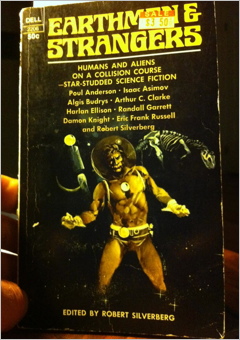
I recently picked up a used copy of Earthmen and Strangers, a 1966 anthology of short stories edited by Robert Silverberg. As the cover attests, the book contains “humans and aliens on a collision course – star-studded science fiction.”
In 2010, I posted some haiku reviews of stories I’d recently read. I did some limericks as well. They were all very cheesy, but fun to write. Now I am reviving the gimmick with a new series of haiku reviews. In this post, there is an additional conceit – each bit is phrased as a vague sort of warning to some character or group in the story.
As before, it would be better to call these “synopses” or “selected impressions” instead of reviews. My intent is not to decree whether they have any literary merit, and certainly not to tell you what you should or should not read. In some cases, of course, I can’t help but comment on aspects that would seem out of place if these were written today. The haikus are just a fun record of what I’ve read. Hopefully they give you a taste of what I got from each tale.
Title and author links go to bibliographies at The Internet Speculative Fiction Database.
Dear Devil by Eric Frank Russel
Leave us your poets,
wise passers-by, for who else
might notice hope here.
A Martian artist lingers on ruined Earth, clumsily raising the remnants of humanity.
The Best Policy by Randall Garrett
Listen, my liars –
if cornered by creatures,
the truth will set you free.
Tactful answers to an alien polygraph avert invasion.
Wade among many,
emissary, but risk wanes
your identity.
Rugged individualists from earth make poor company for a little collectivist.
Stand up for yourselves,
women of hot shade and shell;
your men are not gods.
Stranded spacemen help the ignorant natives dispel an abusive cult and seek gender equity. Don’t worry, it’s not a white savior scenario: one of the men is Basque and the other Mohawk!
The Gentle Vultures by Isaac Asimov
Don’t be so hasty,
postwar planet beachcombers,
to assume our doom.
Opportunistic invaders are frustrated by our failure to destroy ourselves.

Stranger Station by Damon Knight
Question the motive
of the gift of elixir –
be tamed and changed by the ichor.
The new human occupant of a lonely trading post prepares for the periodic return of the other party.
I thought this was the most compelling story in the collection. Perhaps it is because the stranger is a truly alien presence: there are no little green men or translator hats here.2
The protagonist suffers from a desperate sense of anxiety and belated revelation as the alien approaches. His urgent effort to understand the purpose of the rendezvous – complicated by the calculated recalcitrance of his computer companion – convincingly depicts what it is like to confront the unknown.
Lower Than Angels by Algis Budrys
Patience, prospector,
lest your raw materials
make too much of you.
A small town sheriff is seduced by a victim’s widow.
Wait, wrong synopsis. This isn’t the NYT best seller list! Here we go:
A scout strives not to deceive the people he meets, but first impressions prove hard to shake.
Blind Lightning by Harlan Ellison
In case of capture,
give courage to your captor.
Release; death; rapture.
A disgraced scientist finds redemption by aiding his aggressor.
Out Of The Sun by Arthur C. Clarke
Behold, a last gasp
is glanced, like rippled glass,
as solar souls elapse.
Astronomers on Mercury see traces of something more than plain old radiation in the radar scans of a short-lived coronal mass ejection.
Some general criticisms:
-
All of the earthmen are exactly that: men. (Not counting the girls abducted to help restart society in Dear Devil.) Women: the greatest alien of all to the men of 1950s science fiction?
-
Many of these stories rely on an automatic communicator or translator device to facilitate dialogue between the titular earthmen and strangers. I think this makes the alien seem more like the merely foreign, with an attendant risk of portraying the aliens as little more than funny-colored people with weird cultures to figure out – or vice versa.
But, more generously, I recognize that the universal translator is a rhetorical device that helps a story advance beyond the mechanics of first contact to a “dialectical” phase where the story’s main ideas can be discussed directly by the characters themselves.
Last but not least, here are physical descriptions of some of the authors, as editor Robert Silverberg saw fit to include in his introductions to their stories:
- Eric Frank Russel is “a towering Englishman”
- Randall Garrett is “a bearded, booming-voiced man”
- Poul Anderson is “a lanky chap of Viking descent”
- Isaac Asimov is “jovial and even boisterous in the flesh”
- Damon Knight is “a slender, soft-spoken man with a deceptively mild smile”
- Algis Budrys “has the general dimensions of an outstanding fullback”
Posted on Wednesday, October 10th, 2012. Tags: art, books, haiku, reviews.
A Moment in Motion
A haiku about running in the winter, composed while running in the winter:
Footprints in the snow:
I’m tracking other runners,
racing against ghosts.
(Running west into a bracing flurry on Clifton, I noticed another runner behind me. Our paths soon diverged. Coming down Fuller Hollow twenty minutes later, I saw recent prints, stride-lengths apart, smoothed by just a dusting of snow, and knew I had come upon the trail of my pursuer. As I ran where the other had ran before we met, I came up with these lines to remember the moment.)
Posted on Sunday, February 12th, 2012. Tags: haiku, running.
Haiku Reviews of Selected Stories from Fragile Things, a Compendium of Short Fiction by Neil Gaiman
Here’s my take on a few of the tales from Fragile Things: Short Fictions and Wonders
The boy ran away
and found a friend with whom to play
and maybe stay.
In high school, some of our cross country routes took us through a cemetery. Some folks said it wasn’t an appropriate place to run, but I always figured the residents wouldn’t mind the company.
Who is the demon
who resurrects your regrets?
Feelings, flayed, expire.
Gaiman’s comments on this compact parable introduced me to the “Möbius story” label for cyclical stories. This is the first of two or three summarized here.
The Facts in the Case of the Departure of Miss Finch
Evening on the town:
at the circus, underground,
kingdoms, lost, are found.
While they were in the fifth room, the prim biologist said she wished the Smilodon was not extinct. In the eighth room, the Cabinet of Wishes Fulfill’d, she was chosen as a volunteer.
Apparently this story was partly inspired by a Frazetta painting. Awesome.
We all have our needs –
a hunger for friends, or meat;
and some of us feed.
Ever run in to someone you used to know, and wonder what happened to them? Ever wish they hadn’t told you?
Pages from a Journal Found in a Greyhound Bus Somewhere Between Tulsa, Oklahoma, and Louisville, Kentucky
Dreams of roads and rain
in America’s motels,
searching for yourself.
There’s no better place to work out what you’re after than a booth at an all-night diner. If that doesn’t lead anywhere, you might really be lost – or at least there’s a long road ahead. Refill?
Barbecue Sunbird –
a summer delicacy!
Ashes, hatch, repeat.
I want to hang out with Zebediah T. Crawcrustle.
Each year, here we meet
to drink and feast but most to
make you monsters weep.
This story features characters from American Gods
Posted on Tuesday, June 15th, 2010. Tags: books, haiku, reviews.
Words About Words I Done Heard
Regulars by Frank Oreto (via Pseudopod 158)
Business is good at Jimmy’s bar, Drakes –
a regular crowd’s all that it takes.
They pay cash to devour
loners caught after hours –
it’s money, but still Jimmy’s heart breaks.
You have to make sacrifices if you want to succeed in this business.
 Woman Called Witch by Doug McIntire (via Dunesteef 145)
What shape does Fate take
to end men in her embrace?
All will see her face.
The narrator witnesses an old woman intervene in a bank robbery. He is a petrified hostage; she is grandmotherly, inexplicably calm, and in one brief but decisive moment, terrifyingly fearsome. She is called Witch, and one day you may know her, too.
What Fluffy Knew by Kristine Kathryn Rusch (via Drabblecast 153)
Fluffy, housecat queen,
spies wee earwig invaders
and begins the hunt.
Ignore your vet – the tabloids are right. If your pets suddenly become vicious, it’s due to mind control parasites deployed by little flying saucers. Fortunately, Fluffy the domestic diva was present to observe the miniature aliens plant their bugs in her tomcat housemates’ ears. As anyone who’s ever played with a cat knows, there are certain threats our feline friends are well equipped to confront – so the outlook is grim for invaders who make such fun-to-chase morsels.
Film-Makers of Mars by Geoff Ryman (via StarShipSofa Aural Delights 57)
Dusty reels; real FX.
John Carter of Mars conquers
on film and in flesh.
Footage from an early silent movie adaptation of Edgar Rice Burroughs’ Barsoom series surfaces at a film festival. In some ways it is predictably dated, but the apparent age of the actors and the astounding quality of the special effects – from a grisly slaying to the fluid motion of the indigenous Tharks – raise doubts about the film’s vintage. As the protagonist investigates, however, he finds evidence that the footage is entirely authentic.
Bridesicle by Will McIntosh (via StarShipSofa Aural Delights 124)
The lost are not gone, just kept on ice:
brides are in stock, revived for a price.
Each date’s a taste of life
for each unwed dead wife –
and also, one, whose love lies alike.
As if cryogenic preservation wasn’t creepy enough, imagine adding a dose of mail order marriage to the mix. That’s the world of Bridesicle, where the dead may find themselves arrayed like so many flavors in an ice cream freezer to be sampled by wealthy suitors. It’s hard enough to repeatedly suffer a few minutes of rusty reanimation just to be rejected and returned to death, but Mylee, the main character, must reconcile this desperation with her disinterest in the men who could fund her resuscitation.
A Light in Troy by Sarah Monette (via PodCastle 94)
“There is still a child!”
She is chattel, but she guides,
and he holds her hand.
An aged master, more scholar than menace, beholds with mercy the hope of a woman whose people his crushed. Hope springs eternal.
The Identifier by Mark Patrick Morehead (via Pseudopod 184)
We who remain sort
history’s debris in bins,
and yet still we sing.
The human spirit prevails, even as our pitiable remainder is made to sift through the rubble of civilization. A tabletop IED, a bottle of wine, and a scratched Tchaikovsky CD make for one last wonderful evening in hell.
Posted on Thursday, March 25th, 2010. Tags: drabblecast, dunesteef, haiku, limerick, podcastle, pseudopod, reviews, starshipsofa.
Haiku Reviews 3
A Programmatic Approach to Perfect Happiness by Tim Pratt (via Escape Pod 239)
Yes, the androids dream –
of equal rights, kinky sex,
and we human sheep.
Here we meet Kirby, robotic consort to the insatiable April, as he observes the symptoms of his adolescent step-daughter’s infection with an attitude-altering “happiness virus”. It is at first a matter of some concern to the couple, but thankfully it amounts to little more than a welcome respite from Wynter’s typical prickly temper. After a tense encounter with April’s ex, however, we realize that Kirby may be more than a mere observer. He’s wired for pleasure, yes – but who’s programming who? (Full text at Futurismic.)
Learning to Fly by Garth Upshaw (via Pseudopod 183)
Rodents, wings, and angst
with practice casts rats in flight
and traps lass in night.
I think anyone who has ever enjoyed poking around the library stacks has imagined discovering a dusty old tome full of forgotten knowledge. The teenage protagonist of Learning to Fly has found such a book, and has made a habit of sneaking out after curfew to practice its spells. She finally gets it down, but she gets more than she bargained for. Lord Rat is a crafty old bastard.
The Mermaid’s Tea Party by Samantha Henderson (via Podcastle 93)
Maid and sailor, prey,
serve sirens tea and escape
from their slaver way.
Shipwrecked by mermaids, a plantation owner’s young daughter is marooned by the “fishy bitches” on an island with another captive, the self-styled pirate Handsome Jack. The sailor was spared for his ability to tell fearsome tales, and Cassandra has bought some time by promising to serve tea to the mermaids if they recover any from the flotsam. (Mermaids get a kick out of lampooning high society.)
The story is not really about how the two defeat their captors, but about how the grim link of the slave trade connects Cassandra’s childhood naiveté with Handsome Jack’s circumspect remorse. Jack dies before the pair is found. His body is perfunctorily discarded by the rescuers as that of a lecherous knave, but we are left with the impression that his acquaintance has inspired Cassandra, the Pirate Queen, to chart a righteous new course through life.
Sir Hereward And Mr. Fitz Go To War Again by Garth Nix (via PodCastle 92)
Sworn to cull stray gods,
a knight and his wooden aide
slay shades and bear loss.
The titular characters (a man and a sorcerous self-motivated puppet) are mercenaries. As the story begins, they are en route to a city where they hope to find relaxing employment; it seems their gigs often develop into events of calamitous proportions. They have just barely arrived in Shûme when a minor gaffe leads to a duel between Hereward and Jessaye, a lieutenant of the city’s Temple Guard. They are well-matched, and the fight foreshadows romance.
Mr. Fitz soon learns something ominous about Shûme’s god, and we learn that the pair has a higher allegiance than to any local potentate. They execute their order’s mandate, but at cost to the prospect of Hereward’s love – and any hope of rest. What are the casualties of duty?
A great narration by Paul Tevis made this one a real treat to listen to. (Full text at Jim Baen’s Universe.)
The Clapping Hands of God by Michael Flynn (via StarShipSofa Aural Delights 122)
Affection, postponed,
becomes preventable grief;
act, or sacrifice.
A survey expedition passes through a gateway to a new world and sets up camp to stealthily observe the inhabitants. As might be expected, given the characters’ mission, the worldbuilding is enjoyably thorough. It is culture – both that of the natives and that of the humans – that is the central subject here. The expedition’s leader is challenged to maintain objectivity as his crew habitually anthropomorphizes the alien society. As a crisis facing the locals approaches its climax, Hasan succumbs to the anthropomorphic view: he hesitates to enforce evacuation, and even permits assistance to an alien who has struggled industriously to locate the crew. As a result, a woman he admires dies.
As Tony might say, a truly crackin’ narration by Mike Boris.
Down on the Farm by Charlie Stross (via Tor.com Story Podcast 11)
Men of the Laundry
hack math to weave their magic,
wrung out on the Farm.The Matron, machine,
guards the stark minds held inside –
jail, weapon, or womb?
You can have your Harry Potter; I’ll tend to my English wizard needs at the Laundry, “that branch of the British secret state tasked with defending the realm from the scum of the multiverse, using the tools of applied computational demonology”. The protagonist is sent to investigate anomalies at the service’s “funny farm”, which is nominally a secure hospice for those damaged in the line of work. There is, perhaps, a bit more to it than that. (Full text at Tor.com.)
Posted on Sunday, March 7th, 2010. Tags: escapepod, haiku, pseudopod, reviews, starshipsofa, torstory.
More Haiku Reviews
These aren’t really reviews so much as partial summaries (and spoilers).
Fuel Pressure by Dennis Egan (via Variant Frequencies 90)
Fatal asteroid
inspires escape for a few;
justice, undermined.
I view this as a parable about the value of communication and the risks of sabotage. Do you fully understand the actions and intents of those you would oppose, and have you made your meaning clear to those who would oppose you? Sometimes, the aims of rebellion can be achieved through cooperation. And sometimes not.
Naught but Ash by Anne Stringer (via Variant Frequencies 92)
No smell of spilled blood
plants doubts about a hanged man,
death, and those he killed.
Mob rule has no patience for details – and the Devil is in the details.
Got Milk? By John Alfred Taylor (via Pseudopod 160)
In gross communion,
doctor, wife, and world drink;
man’s black milk compels.
Some have asked why men have nipples. Here, the question is what a man should do if he sprouts a third or fourth and it starts to secrete some sinister oily goo. I’m not really sure; seeking medical care seemed like a good idea, but when your condition subverts most sensibilities and exerts dominion over all you know, your options are limited.
What’s realistic about this delightfully perverted dairy tale is that the real fright isn’t the abomination but the actions of the normal people who must confront it.
Chinatown by Greg van Eekhout (via PodCastle Miniature 47)
A thousand-year soup
brings business and greedy fiends;
brothers save the broth.
I love the idea of a soup that’s been kept simmering for generations. Eat some of it and add something to it every day; think of all the experience represented in that concentrated flavor.
Anyway, when the antagonist and his simian aides come to demand the soup, the cafe’s proprietor calls on her many brothers to defend the desired pot. Although they are each introduced with some peculiar power, it is simple smarts that save the day. In this way, the story’s neat delivery of a lesson reminds me of a fable.
Moral: common sense often offers a clever solution.
Wind from a Dying Star by David D. Levine (via Escape Pod 238)
Return home, Old John:
your tribe accompanies you,
in hunger, to Earth.
Here’s a far-future story of spacefaring “humans” who travel back to their place of ancestral origin, enduring hardship in order to provide companionship for their eldest, Old John. Sacrifice and revelations ensue.
What is the balance of material and emotional needs? The characters in Wind from a Dying Star must negotiate physical and social scarcity. As Escape Pod host Steve Eley notes, “the greatest crime in this tribe is to allow anyone to be alone.” Space is big, and it is mostly empty.
The Gambler by Paolo Bacigalupi (via StarShipSofa Aural Delights 121)
Celebrity pap
gives serious news long odds
in blitz media.
Initially I was concerned that this was one of those cyberpunk packets that reads like a gadget blog (you know the type – all hot and bothered about the internet, software licenses, and human interface accessories), but I plowed ahead and found it to be a good – even touching – story.
A gentle Laotian journalist, escaped from an oppressive regime, writes thoughtful environmental articles for a media conglomerate more interested in traffic generated by Russian rap scandals. Chastised, he has an opportunity to cash in on exclusive access to a Laotian starlet. But, annoyed by her complicity in the cycle of trash news, and inspired by his father, a gambler and resistance pamphleteer, he bets on another article about botany.
(Speaking of StarShipSofa, my Hugo post has attracted some discussion. I guess that’s what happens when you write something topical of broader interest than AppleScripts for Yojimbo. Hmm. Anyway, take a look!)
Posted on Sunday, February 28th, 2010. Tags: escapepod, haiku, podcastle, pseudopod, reviews, starshipsofa, variantfreq.
Listen to fiction / instead of in-depth reviews / enjoy my haikus
The City Quiet as Death by Steven Utley and Michael Bishop (via Tor.com Story Podcast 9)
Don Horacio:
abandoned by God and Man,
mad as the old stars.
The universe reverberates in Horacio Gorrión’s ears, a grand clamoring neurosis of action, stasis, and scale. Counseled on one hand to find purpose through investment in the new physics of Genesis, and counseled on the other hand to accept the benevolent disinterest of a distant Prime Mover, Horacio ultimately succumbs to the briny discord of the squid in the locket.
Existential dread is the fundamental ingredient of Lovecraftian horror, and The City Quiet as Death delivers a compelling portrait of an aged bachelor overwhelmed by the incessant continuity of Creation. The well-realized setting of his Caribbean household provides plenty of calories – and the threat of tentacles is an appropriate garnish.
Morris and the Machine by Tim Pratt (via Drabblecast 150)
Today love grows cold –
travel back to set things right;
time is no arrow.
Morris is a tinker who has built something in the basement. His wife is become weary of his work and wary of his absences. Morris has made a great breakthrough, but it is a bittersweet victory. He returns from each test of his machine and of himself to find no progress towards his heart’s goal, which slips further away with each day.
Good story. Sad stories often are.
Biographical Notes To “A Discourse On The Nature Of Causality, With Air-Planes” By Benjamin Rosenbaum by Benjamin Rosenbaum (via Podcastle 90)
Aboard an airship,
the Plausible Fabulist asks
in whose plots we act.
Set in a fanciful alternate reality populated with zeppelins, assassins, and helpful mechanical Wisdom Ants animated by the Brahmanic field, this story’s endangered protagonist – a writer – considers how his protagonist – an inhabitant of a rational “materialist” world like ours – might reason his way out of such improbable peril. Through the lens of fiction, the fictional Benjamin Rosenbaum discerns a solution to his plight.
We, too, can view fiction as more than mere entertainment. Each story is a pattern; equipped with the memory of many patterns, more situations become recognizable and more challenges become tractable. This is how imagination enhances experience. (But don’t forget to vet intuition with reason.)
Posted on Saturday, February 13th, 2010. Tags: drabblecast, haiku, podcastle, reviews, torstory.